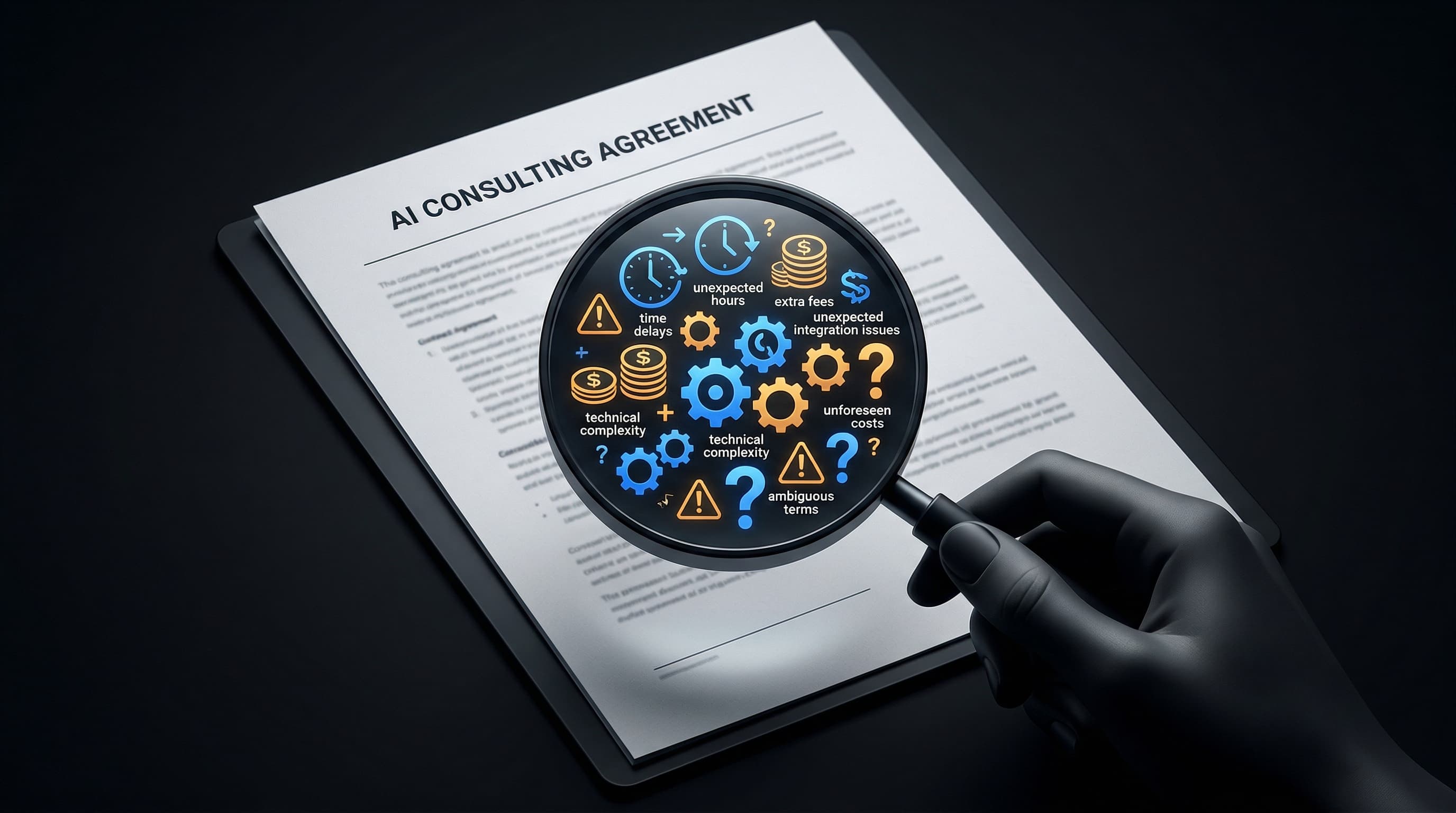
AI consulting has a dirty secret. The price on the proposal is almost never the price you end up paying. Not because consultants are dishonest, but because AI projects are genuinely unpredictable. Here are the hidden costs nobody warns you about, and how to protect yourself.
Hidden cost #1: The discovery that never ends
Most AI consultants charge for a "discovery phase" before the real work begins. The problem: discovery can stretch for weeks or months. What starts as a £2,000 discovery becomes a £5,000 discovery because "the problem was more complex than expected."
Red flag: if discovery has no fixed end date, you're writing a blank cheque.
Hidden cost #2: The "nice-to-have" problem
Here's an uncomfortable truth from a data scientist who spent years in the field: "For most businesses, AI is a nice-to-have rather than a must-have." This means your AI project is never anyone's top priority, not yours, not your team's. It keeps getting pushed back, and you keep paying retainer fees while nothing ships.
Hidden cost #3: The subcontractor markup
Solo consultants who take on bigger projects often subcontract the technical work. You're paying the consultant's rate, plus their margin on the subcontractor. A £15,000 project might have £5,000 going to the person who actually builds it. The consultant becomes a project manager, which might not be what you were paying for.
Hidden cost #4: The integration nobody scoped
AI doesn't work in isolation. It needs to connect to your email, your CRM, your accounting software, your file storage. Integration complexity is the number one budget killer. A consultant quotes for "building the AI", but connecting it to your actual tools can double the cost.
Hidden cost #5: The maintenance nobody mentioned
AI systems need care. Models get outdated. APIs change. Your business processes evolve. That "one-time" build now needs ongoing maintenance, and the consultant who built it is the only one who understands it. You're locked in.
How to protect yourself
- Demand a fixed price, not hourly. If they can't estimate, they haven't understood the problem.
- Ask for a timeline with milestones. Weekly deliverables, not quarterly reviews.
- Ask who actually builds it. If it's subcontracted, you should know.
- Insist on documentation. You should be able to maintain it without them.
- Start small. One process, one automation, prove it works, then expand.
- Ask about ongoing costs. Monthly hosting, API fees, maintenance, get the full picture upfront.
The alternative: fixed-scope sprints
Some providers (including us, obviously) work differently. Fixed price. Fixed timeline. One specific problem solved. If it doesn't work, you know within days, not months. The risk is shared, not dumped on the buyer.
The best way to avoid hidden costs is to make them visible before you start.
A real cost breakdown: what £15,000 actually buys
To make this concrete, here is a representative breakdown of where the money goes on a £15,000 AI consulting engagement priced on time-and-materials, versus a £1,950 fixed-price sprint covering roughly the same scope. I am using real numbers from projects I have seen (my own and competitors') on the UK market in 2026.
Time-and-materials engagement, £15,000 total:
- Discovery phase (4 weeks): £4,500. Two weeks of interviews, one week of writing a requirements document, one week of revising the document after the client flags things they didn't say in the interviews.
- Strategy / roadmap document (2 weeks): £3,000. A PDF nobody on the client side will read past page 5.
- Technical architecture (1 week): £1,500. Diagrams of what will be built, in principle.
- Implementation (3 weeks): £4,500. The actual work. Often subcontracted to a developer at £400/day while the consultant invoices at £1,000/day.
- Handover meeting and documentation (1 week): £1,500. A Zoom call and a Google Doc.
Total elapsed time: 11 weeks. The client receives a working system, kind of, at the end of week 11. Anything not in the original scope is change-requested at additional cost.
Fixed-price sprint, £1,950 total:
- Pre-sprint audit (1 week): included. Identifies the highest-ROI workflow and confirms feasibility. If nothing qualifies, the client pays nothing.
- Build phase (2 weeks): included. The actual working automation, delivered, tested, integrated with the client's existing tools.
- Handover and training (inside the 2 weeks): included. The team using it actually learns to use it.
- 30 days of email support after delivery: included.
- 90-day action plan with 5-10 additional opportunities: included.
Total elapsed time: 3 weeks. The client receives a specific, documented, working automation with training complete and support in place.
The two engagements do not deliver the same thing. The £15,000 engagement tends to deliver a broader architectural picture that may or may not ever get implemented. The £1,950 sprint delivers one working workflow. For most small businesses, one working workflow shipping next month is worth more than a strategic vision shipping in three months' time.
UK-specific hidden costs most consultants don't mention
There is a layer of hidden costs specific to operating in the UK that rarely appears in proposals. If your consultant hasn't raised these, that alone is a red flag.
ICO registration and data protection impact assessments. If the AI system processes personal data (and most do), you may need a DPIA under UK GDPR Article 35. A DPIA is not free to produce. It takes 2-4 hours of a competent person's time per system and the output should be reviewed by your DPO if you have one. For regulated sectors like accountancy and law, the DPIA is effectively mandatory. If the consultant is not producing one as part of the engagement, you will be paying for it separately later.
HMRC data residency for AI APIs. If your AI system processes tax data, client financial data, or anything HMRC might audit, you need to know where the data is actually processed and stored. Many of the major AI APIs (OpenAI, Anthropic, Google) have UK/EU data residency options on enterprise tiers, but you have to explicitly contract for them. The consumer API tier is US-residency by default. Discovering after deployment that your accountancy firm has been sending client data through US servers in violation of your own client engagement letters is a genuinely expensive problem to unwind.
SRA compliance documentation for legal firms. If you run a law firm, the SRA expects you to document your approach to AI under the 2024 guidance on AI in legal practice. This is a compliance deliverable that should come bundled with the implementation. If it doesn't, you are buying technology without the compliance wrapping, and the wrapping is the part that keeps your firm out of trouble.
Cyber Essentials and Cyber Essentials Plus re-certification. If you already hold CE or CE+, adding a new AI system to your stack may require re-evaluation at your next annual audit. The re-audit cost is not huge (usually £300-£1,000) but it is a cost that rarely appears in the original AI proposal.
VAT on cross-border AI API services. UK businesses buying AI API credits from US-based vendors face VAT reverse-charge complications if they are not properly registered for EU/UK VAT treatment of digital services. This is a finance-department headache that creates genuine accounting work later. Fixable, but not free.
None of these are individually catastrophic. Together they can add 10-25% to the true cost of an AI project over the first year if they are not handled upfront. A competent consultant brings them up in the discovery call, not after the invoice is paid.
Fixed-scope versus time-and-materials: the comparison that matters
Here is the direct comparison, with the tradeoffs visible:
Fixed-scope sprint (e.g. £1,950 for 14 days)
- Price certainty: complete. You know the total cost before signing.
- Scope certainty: complete. Defined before work starts.
- Risk to buyer: low. If the work overruns, the provider absorbs the cost.
- Risk to provider: moderate. Provider has to scope accurately or lose margin.
- Best for: defined problems with known solutions. First AI project. Budget-constrained businesses.
- Worst for: exploratory research or problems where the solution is genuinely unknown.
Time-and-materials engagement (e.g. £1,000/day × 15 days)
- Price certainty: none. Final invoice can be 2-3x the original estimate.
- Scope certainty: low. Scope creeps as the work reveals new complexity.
- Risk to buyer: high. Overruns are paid by the buyer.
- Risk to provider: low. Provider gets paid for all time spent.
- Best for: genuinely exploratory projects with unknown solutions. Enterprise budgets with reserves.
- Worst for: small businesses, first AI projects, any situation where a budget overrun would cause pain.
The honest answer: most small business AI projects are not genuinely exploratory. The problem is known (too much email, too much admin, too much manual data entry) and the solution pattern is known (automate it). Time-and-materials pricing on a known problem is paying for the provider's lack of confidence in their own estimate. You are being paid to take their risk.
How to read an AI consulting proposal like an adult
If you get a proposal in front of you, here are the specific things to check before you sign.
Is the total price fixed or estimated? If the word "estimated" appears anywhere near the price, you are on time-and-materials. Treat the quoted figure as a floor, not a ceiling.
Is the scope a specific outcome or a list of activities? "We will run a discovery phase" is an activity. "We will deliver a working automation that reconciles your bank transactions, integrated with your Xero account, with full handover documentation" is an outcome. Outcomes are contractable. Activities are not.
Who is doing the work? Ask explicitly. If the answer is vague, assume subcontracting. There is nothing wrong with subcontracting provided you know who the subcontractor is, what their experience is, and that they will still be available for post-delivery support.
What happens if the project fails? Every proposal should answer this explicitly. "Full refund if we cannot identify a viable use case during Week 1" is an answer. "We will work with you to find a path forward" is not an answer, it is a way of saying you are on the hook no matter what.
What are the ongoing costs? Monthly model costs, hosting costs, maintenance, retraining. Get the number. If the consultant cannot give you a number, they have not actually built the thing before.
What is the handover format? You should receive documentation that another developer could read and maintain. If you receive only verbal instructions and a login, you are locked into the consultant for the system's entire lifetime.
The honest bottom line
AI consulting is not fundamentally different from any other consulting. The bad providers overcharge, over-scope, under-deliver, and make themselves indispensable. The good providers commit to specific outcomes, price them fixed, and make themselves unnecessary after delivery.
The hidden costs in this article are real, but they are only hidden when the consultant wants them hidden. A transparent provider brings them up in the first conversation. A defensive provider gets cagey when you ask. Pay attention to how your questions are answered, not just what is in the proposal.
The best way to avoid hidden costs is to work with someone who has already done the project you are trying to do, knows what the real costs are, and is willing to commit to a fixed price because they know the number. If you cannot find that provider, you are probably looking at a project where the risk belongs with you anyway, and the honest answer is to build a smaller first step, see what it really costs, and scale from there.
Done small. Done fixed-price. Done fast. That is how you get value out of AI without the hidden costs eating the value you bought.
Ready to automate?
Book a free 20-minute audit. We find the highest-ROI automation for your business in 14 days.
Get your free automation audit